
Sickness is not the norm.
Health is built systematically.
For 20 years we complained that modern medicine only treats symptoms once it's already too late. Enough complaining. PRIMEGLOW is a health operating system: it combines modern nutrition science, ancient knowledge of the body, and wearables in a single ecosystem. See your inner processes in real time and stop diseases before they ever start.
PRIMEGLOW is a health-building system with nutrient tracking, AI, and gamification.
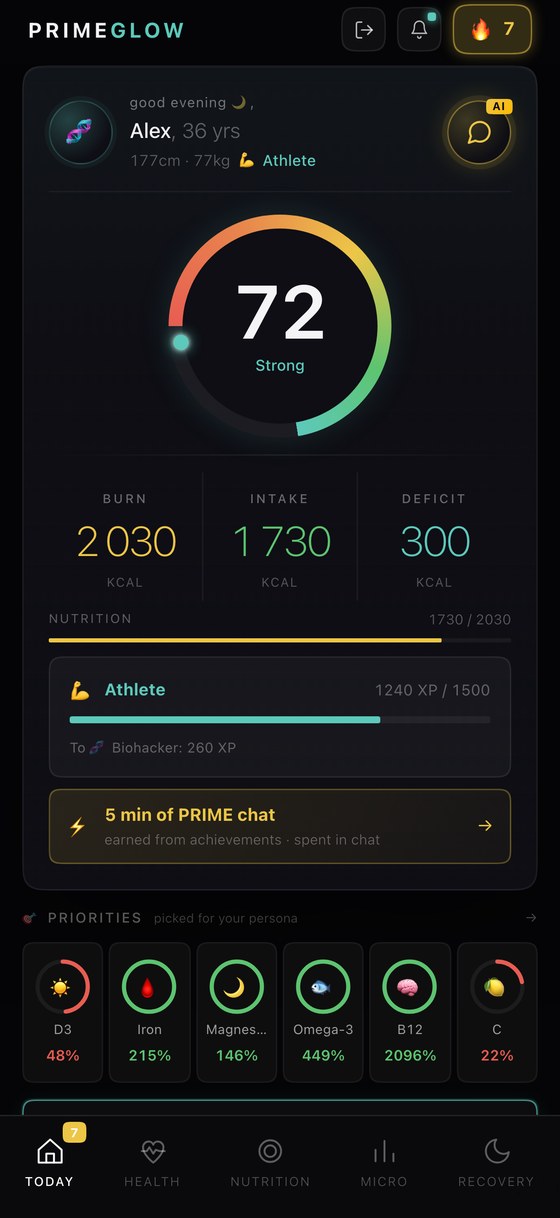
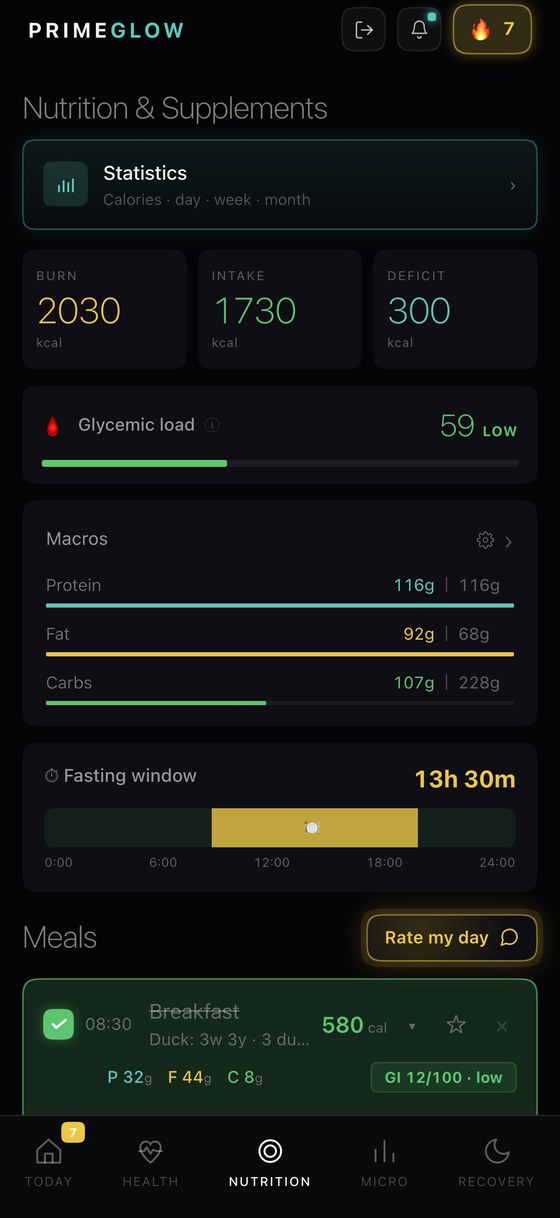
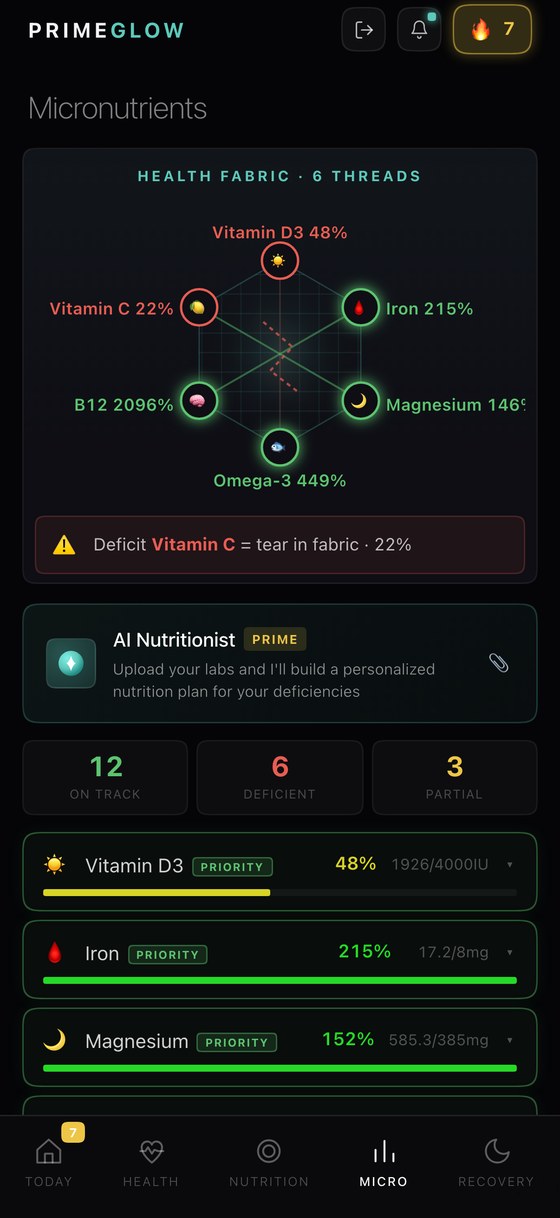
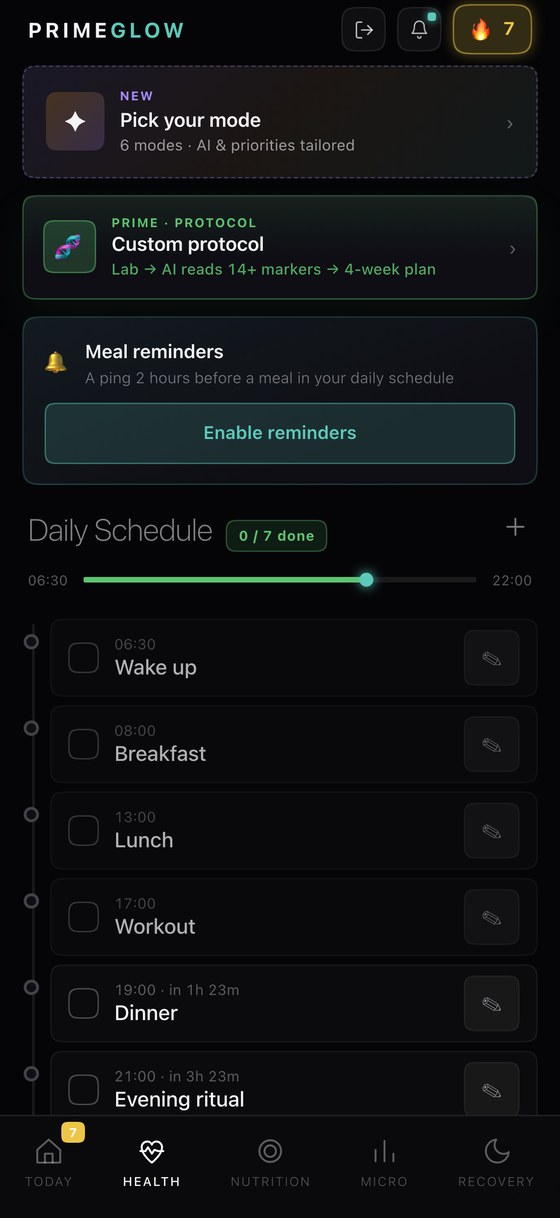
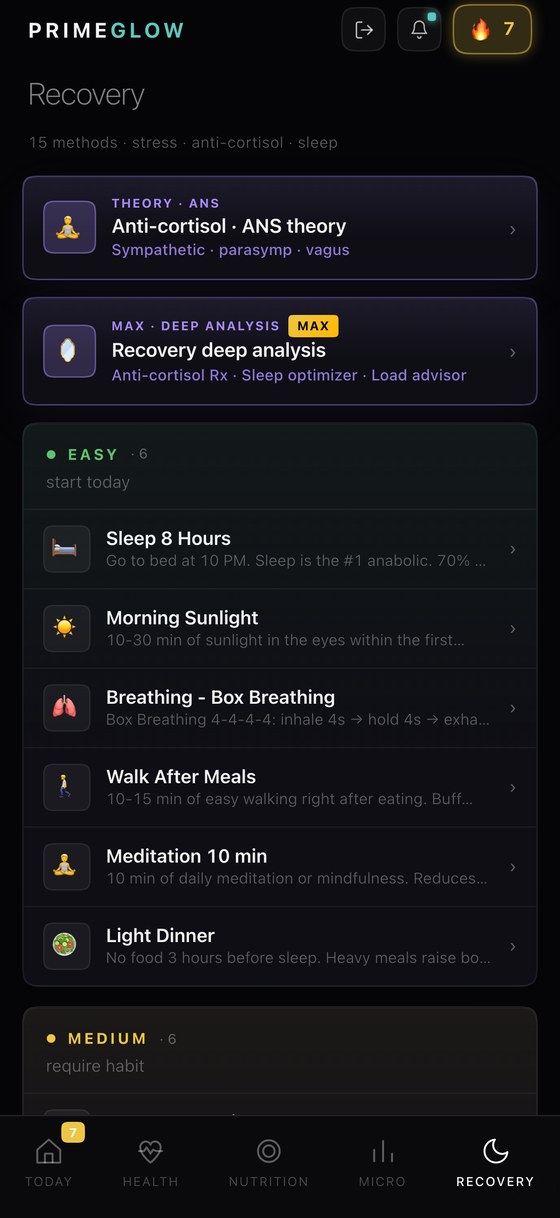
One screen - one day of your health
Morning: open the app - see your Score, bio age, biometrics, priorities. Midday: snap your meal → AI does the math. Evening: supplement checklist. All in one flow.
Early round in PRIMEGLOW
PRIMEGLOW is an AI-powered nutritionist app. It knows the context of one specific person: their blood work, diet, daily routine, and goal - and tells them every day exactly what to eat, which supplements to take, and why. Not a "calorie table," but a personal plan that comes alive around the user.
Funding in three phases: €33,330 → €100,000 → €1,000,000 (≈ 2.9M → 8.7M → 87M ₽). Each next phase opens only after the previous one's result is proven. The founder keeps control - 72.09% after all three. Straight equity, not a convertible note - for simplicity and deal speed.
Health is the most expensive information asymmetry
In Russia and the CIS, a "biohacker" spends 20,000-60,000 ₽/mo on lab tests, supplements, fitness, and doctors - yet has no single place where it all connects into a system. Local apps lag behind, and Western ones don't understand the Russian-language context (local labs, local reference ranges, local food, local medicine).
Calorie counters without context
FatSecret, MyFitnessPal, and local food-diary apps track calories - but never explain what to change. Micronutrients, deficiencies mapped to local supplement catalogs, recommendations that understand Russian/Caucasian/Central Asian cuisine - all out of scope.
Wearables → data without action
Whoop (~30,000 ₽/yr plus hardware), Oura, and Apple Watch collect biometrics, but the recommendations are shallow: "sleep more." Without integration with nutrition and lab work - weak value for someone paying for results.
Lab tests → a PDF with no plan
You get tested at Invitro or Gemotest - and receive a PDF with reference ranges. What do you do with "vitamin D = 18 ng/ml"? See a nutritionist at 5,000-15,000 ₽/hour. Only 1-3% of the audience has that kind of access.
What's needed is not yet another app, but a health operating system: input - lab tests + biometrics + nutrition; output - a concrete 4-week protocol that updates daily. All of it in Russian, with an understanding of local labs, supplements, and habits.
PRIMEGLOW · The AI nutritionist that knows your context
A Personal Health Operating System: it connects lab tests, nutrition, training, sleep, and daily routine into a single graph. An AI agent runs on that graph and delivers personal actions - based on your lab data, not generic advice from the internet.
Health Score · 4 pillars · rainbow gradient
A single 0-100% health score built on Macro / Micro / Training / Sleep. The visible rainbow progress is the core retention driver. It grows as deficiencies actually get closed.
6 Modes · personal protocols
Cutting · Bulk · Recovery · Hormonal · Brain · Maintenance. Each Mode rebuilds the recommendations for food, supplements, training, and daily schedule. Switchable anytime. A unique edge over calorie counters.
AI nutritionist · lab-based
Snap a photo of an Invitro/Gemotest/Helix lab report → AI reads the markers, maps them to local reference ranges, and builds a 4-week protocol. The highest-value UX feature: one step replaces a 10,000 ₽ nutritionist visit.
AI Chat · context-aware (Pro+)
Knows your labs, goals, mode, and progress. "What should I eat for lunch to hit my protein and B12" - answered in seconds. The main paywall trigger for upgrading to Pro+.
Smart Supplements · pescatarian-aware
A deficiency-aware catalog. AI recommends only what closes your identified deficiencies. Understands diets: pescatarian, vegan, custom - with source lists. Deduplicated against a canonical database.
Daily Schedule + Telegram WebApp
A daily grid: wake-up, workout, eating window, supplements, sleep. Checkboxes → XP → streak with Insurance. Tactile feedback via Telegram WebApp (the native channel for the Russian launch market). Milestones: Centurion (100 days), and more.
Bio Age tracker
Biological age from a combination of biomarkers and lifestyle factors. A forward-looking metric - it motivates over the long run far better than "calories burned."
Referral engine · viral by design
Not "invite a friend - get a discount," but "share your health report → 3 friends get free blood-test analysis." 5 virality mechanics built into the product. More below ↓
PWA · functionally complete MVP · primeglow.io
The product is built and deployed: app.primeglow.io, marketing site - primeglow.io. Single-file PWA, React + Babel, Telegram WebApp integration - a native channel for the RU audience.
Stack & technology choices
PRIME BAND - the ecosystem's hardware (early Year 2)
A 24/7 wearable bio-tracker - HRV, sleep, resting heart rate, SpO₂, strain. Everything Whoop can do, but the data flows straight into the PRIMEGLOW AI protocol. It closes the loop: software reads food and labs, hardware reads physiology. A hardware lock on the subscription → LTV up, churn down. Whoop/Oura are unavailable in Russia - we fill that vacuum with our own device.
Six segments - six funnels
This is not six apps. It is one AI that speaks in six voices - tuned to each person's data and language. One engine, six entry paths: from first touch to renewal. Expand any persona to see the full funnel and the product features built for it.
Why six paths instead of one
A biohacker needs the word "HRV" and unlimited AI - for a mom, the same app has to say "3 ingredients" and not scare her off. The very same engine (labs by photo · symptoms→protocol · nutrient tracking) shifts its tone, emphasis, and tier per segment. Touch, trial, aha-activation, payment, and renewal are different for each - and so is the acquisition channel.
Burnout is a cross-cutting layer: it is a state, not a demographic. It overlaps all five personas (IT, finance, medicine, entrepreneurs) and brings people who are looking for a "system", not "yet another app". That is why six funnels deliver the mom's wide TAM, the hormonal segment's high LTV/CAC, and the biohacker's premium ticket - without diluting the product.
Not spreadsheets and pain points - real people
Every persona is a real person with their own mornings, habits, fears, and things they already pay for. Sergey from the CFO segment, after a minor heart attack, spends ~$5,500/yr (~520,000 ₽/yr) on a cardiologist, an endocrinologist, labs, omega-3, CGM. PRIMEGLOW at $199/yr = 4% of that budget.
Sergey · 52 · CFO · post-heart-attack
His cardiologist gave him 6 months to bring HbA1c from 5.9 → ≤5.5. ApoB ≤70. Otherwise - lifelong statins + the risk of a second heart attack. Spends ~520,000 ₽/yr on health. Ready to pay for "a guide that doesn't lie".
Aha moment: "I showed my cardiologist the 4-week PRIMEGLOW plan. He called it the best evidence-based thing he'd seen from an app. 12 weeks later my HbA1c was down to 5.4."
Anna · 34 · PCOS · 2 years of IVF
Sees her endocrinologist every 3 months. T4→T3 isn't converting. Between visits - silence. Every "women's" app is about weight loss, while she needs selenium/iodine/iron adjusted for cycle phase.
Aha moment: "PRIMEGLOW showed my selenium was low, so T4→T3 conversion stalls. In 4 weeks ferritin went 32 → 65. Energy +30%."
Alex · 36 · founder · biohacker
Runs labs every quarter. Subscribed to Whoop + Levels + Function Health. Spends ~$8,000/yr. Every app is a fragment - there is no graph that ties the data together.
Aha moment: "I have 14 biomarkers and 5 devices. Nobody connected the dots between them - until I found PRIMEGLOW."
260M Russian speakers · focused on a 14M paying core
Wellness & health apps in Russia - ~12B ₽/yr in 2024, projected ~32B ₽ by 2028 (CAGR ~28%). The CIS adds roughly another 50% on top of the Russian volume. Biohacking and the health-conscious segment is the fastest-growing sub-segment.
Target segments (prioritized by retention & LTV)
Subscription · 3 tiers · real prices
A simple model: free entry, paid features visible but dimmed - a tap opens checkout. That is the point of sale: the user runs into the value on their own and pays for it. Payments - Lemon Squeezy, connected at launch.
All 19 micronutrients, unlimited logging, 1 blood panel/mo, 5 AI questions/day, basic weekly report.
AI Coach (proactive insights), Goal Coach, Photo Timeline, 3 deep AI questions/day, Smart Meal Planning, Restaurant Mode, Streak Insurance, 6 modes.
Unlimited AI realtime, 4 blood panels/mo, Custom Protocols (A/B), 3-way correlations, AI Research Assistant, Family ×2, Beta access, Biomarker Lab Mode 40+ markers.
Current state · pre-launch RU
The product is ready and the MVP is deployed; demand is not yet validated - that is exactly what Round A is for. Domains and infrastructure are in place. All numbers below are plan/forecast, not achieved results.
What is already done (with zero capital)
- → Full PRIMEGLOW product (RU) - 5 tabs, 22 screens, AI Chat, AI nutritionist, 6 Modes
- → Marketing plan at primeglow.io/sales - 9 sections, viral mechanics, a roadmap to $1M MRR
- → Domain primeglow.io registered, product deploy being prepared
- → Tech stack in place: PWA + Vercel + Telegram WebApp + Lemon Squeezy / Stripe
- → Systemic safeguards: canonical supplement deduplication, multi-provider AI abstraction
- → Brand & visual identity: dark UI, iOS-style, monochrome SVG iconography
- → Ready to work with RU influencers: a list of ~30 cardio / endocrinology / biohacking channels
Positioning
Nobody is building an AI-first health OS with a lab-based nutritionist + 6 Modes + Chat + RU/CIS context + Telegram WebApp. Every competitor covers one layer; PRIMEGLOW covers them all.
| Solution | RU UX | AI nutritionist (lab-based) |
6 Modes | AI Chat (context) |
Referral engine |
PWA (no app-store) |
Telegram WebApp |
Health Score 4-pillar |
~ARPU/yr |
|---|---|---|---|---|---|---|---|---|---|
| MyFitnessPal | - | - | - | basic | - | - | - | - | $80 |
| Cronometer | - | basic | - | - | - | - | - | - | $60 |
| Whoop | - | - | basic | - | - | - | - | basic | $300 (HW) |
| Oura Ring | - | - | - | - | - | - | - | basic | $300 (HW) |
| Levels Health | - | - | CGM | - | - | - | - | - | $400 (HW) |
| Function Health | - | ✓ partial | - | - | basic | - | - | - | $500 |
| Headway / BetterMe | partial | - | - | basic | basic | - | - | - | $100 |
| PRIMEGLOW | ✓ native | ✓ first-class | ✓ 6 modes | ✓ context | ✓ 5 mechanics | ✓ | ✓ | ✓ rainbow | $144 |
Our edge in Russia/CIS
Software-only (no hardware lock-in), 80%+ margin thanks to the PWA. AI as the brain, not as a feature. Telegram WebApp + local payment rails = a native RU stack. Deep knowledge of local labs (Invitro, Gemotest, Helix) and supplement catalogs (iHerb analogs + local ones).
The real risk
A big player (Tinkoff Pulse, VkusVill, SberHealth) adds an AI layer within 9-12 months. The window - capture the early-adopter market first and lock in retention through the unique Modes + referral loop. We are not trying to outplay them on their turf - we play our own game.
Virality is built into the product
Not the classic "bring a friend - get 20% off", but a viral loop built on the health report. Users share their results, not a promo code. The approach is proven by Strava, Function Health, ReelsKit, Hookstar.
K-factor 1.4 - every paying user brings 1.4 new ones
This is not marketing - it is a product mechanic. Virality is not glued on top; it is wired into the core: health report, family plan, blood-test-as-reward, biomarker share. Once K>1, CAC drops below $10 and the unit economics turn exponential.
Viral loop · diagram
M-01 · "Take care of 3 friends"
A user brings 3 friends → gets free blood panels as a reward. Cost of the panels via a partner lab: $35×3 = $105. One of the three converts to paid ($199/yr LTV). 2× margin on every chain started.
M-02 · "Biometrics of the week"
Every Sunday - a ready-made infographic: "My week on PRIMEGLOW: sleep 7.5h, steps 67K, ferritin ↑18". A Share button posts it straight to Telegram/Instagram stories. Friends ask for the same report. The Strava effect - proven for years.
M-03 · Family plan -50%
First member - $199/yr. Each next one (spouse/parent/child 16+) - $99/yr. Up to 5 people. Average family ticket $499/yr. Whoop / Oura run this mechanic - families stay for years, not months.
M-04 · "Before and after" in biomarkers
After month 3 - a "Share your result" button: "ferritin 38 → 78, omega-3 4% → 8.5%, sleep 6.4 → 7.6". Function Health built its entire buzz on exactly this - "my biomarkers vs the population" rankings became a viral TikTok storyline.
M-05 · Promo code inside the app
Blogger ad integrations: the promo code is issued not on a landing page, but inside the app after install - on the onboarding screen. Every install = a real lead, not a click into the void. The partner sees the exact audience in their dashboard.
M-06 · "The caring gift" (-50% year)
"Give it to someone close - if you actually care." An annual subscription at 50% off ($99 instead of $199) as a gift certificate for a birthday / Father's Day / New Year / an anniversary. An emotional gift "from the heart", not a coupon. Podcasters sell this perfectly.
The full spec of the viral mechanics with per-chain unit economics - in the Marketing Plan: primeglow.io/sales (section "08 · Viral mechanics").
How much one user brings in
All figures are per paying user per year. The base price a user pays: PRIME €144/yr (≈ 12 490 ₽) (≈ €12/mo) - the core tier. Also Basic €79/yr (≈ 6 900 ₽) and Max €263/yr (≈ 22 900 ₽). Below - the economics and how they scale across three phases. Industry benchmarks come from the public RevenueCat dataset (the largest subscription-app benchmark, 2024-2025).
| Metric | Year 1 · start | Before Phase 2 | Before Phase 3 |
|---|---|---|---|
| Signups (total) | 0 → ~5 000 | ~25 000 | ~250 000 |
| Paying users (~4% conversion) | 0 → ~180 | ~1 000 | ~15 000 |
| Monthly revenue (MRR) | €0 → ~€2.2K 0 → ~190K ₽ | ~€12K ~1.0M ₽ | ~€180K ~15.7M ₽ |
| Annual revenue (ARR) | - | ~€144K ~12.5M ₽ | ~€2.16M ~188M ₽ |
| Customer acquisition cost (CAC) | ~€35 ~3 050 ₽ | ~€25 ~2 175 ₽ | ~€18 ~1 570 ₽ |
| LTV : CAC ratio | ~4 : 1 | ~6 : 1 | ~8 : 1 |
The starting point is 0 users: each phase funds growth to the next milestone, not the other way around. The milestones are pegged to real global-practice signals: a seed round is typically raised at ~€10K (~870K ₽) monthly revenue growing 20%/mo; a scale round at ~€2M (~174M ₽) annual revenue with proven payback.
| Metric | How it is calculated | Value |
|---|---|---|
| Revenue per paying user per year (ARPU) | Tier mix: 30% Basic / 55% PRIME / 15% Max, mostly annual plans | €144 12 490 ₽ |
| Cost per user (COGS) | AI €14 + payment fees €4 + servers €3 + support €3 (≈ 1 220 + 350 + 260 + 260 ₽) | €24 2 090 ₽ |
| Gross margin | (revenue - COGS) ÷ revenue | 83% |
| Annual contribution per customer | revenue × gross margin | €120 10 440 ₽ |
| Average customer lifetime | Annual subscribers ~14 mo, monthly ~6 mo | ~12 mo |
| Lifetime value (LTV) | Conservatively ≈ one year of revenue per paying user | €144 12 490 ₽ |
| Acquisition (CAC) · Year 1 | Paid ads + the first influencers | €35 3 050 ₽ |
| Acquisition (CAC) · Phase 2 | The referral funnel kicks in | €25 2 175 ₽ |
| Acquisition (CAC) · Phase 3 | Referrals drive >50% of new paying users | €18 1 570 ₽ |
| LTV : CAC · Phase 1 → 3 | Healthy ≥ 3:1, excellent ≥ 5:1 | ~4:1 → ~8:1 |
| CAC payback · Phase 1 → 3 | CAC ÷ monthly contribution | ~3.5 → ~2 mo |
| Monthly churn | After month 3, blend of annual and monthly plans | ~6% |
| 12-month retention | Annual subscribers (RevenueCat benchmark - 44%) | ~40% |
Cash flow projection · base case
Where the cash moves year by year: inflow (revenue) minus outflow (COGS + marketing + team) = net flow and end-of-year balance. Start - Tranche A €33 330 (≈ 2.9M ₽); the next tranches unlock as milestones are hit. The scenario is conservative and consistent with the unit economics on this page (ARPU €144 - annual PRIME at 12 490 ₽, 83% margin, ~15 000 paying users by Year 3). FX rate for ₽ figures: €1 ≈ 87 ₽.
| Cash flow · € / ₽ (×87) | Year 1 · start | Year 2 · + wearable | Year 3 · scale |
|---|---|---|---|
| Paying users at year end | ~1 200 | ~5 500 | ~15 000 |
| Revenue | €173k 15M ₽ | €790k 69M ₽ | €2.16M 188M ₽ |
| - COGS (AI · fees · servers) | -€30k -2.6M ₽ | -€135k -12M ₽ | -€370k -32M ₽ |
| - Marketing & acquisition | -€55k -4.8M ₽ | -€210k -18M ₽ | -€340k -30M ₽ |
| - Team & operations | -€80k -7.0M ₽ | -€230k -20M ₽ | -€480k -42M ₽ |
| Net cash flow for the year | +€8k +0.7M ₽ | +€215k +18.7M ₽ | +€970k +84M ₽ |
| Cash balance at year end | €140k 12M ₽ | €1.36M 118M ₽ | €2.33M 203M ₽ |
3-year P&L · base case · CIS
A conservative base case built around RU/CIS launch specifics (paid channel Telegram Ads + Yandex Direct, influencer marketing, viral engine from Year 2). Bear / Bull scenarios are in the "Exit scenarios" section.
| Metric | Year 1 | Year 2 | Year 3 |
|---|---|---|---|
| Paying users · end of year | ~1,200 | ~5,500 | ~15,000 |
| MRR · end of year | ~€14.4K ~1.25M ₽ | ~€66K ~5.7M ₽ | ~€180K ~15.7M ₽ |
| ARR · end of year | ~€173K ~15M ₽ | ~€790K ~69M ₽ | ~€2.16M ~188M ₽ |
| Revenue (realized) | ~€173K ~15M ₽ | ~€790K ~69M ₽ | ~€2.16M ~188M ₽ |
| COGS (~17%) | -€30K -2.6M ₽ | -€135K -12M ₽ | -€370K -32M ₽ |
| Gross profit | ~€143K ~12M ₽ | ~€655K ~57M ₽ | ~€1.79M ~156M ₽ |
| Marketing (CAC) | -€55K -4.8M ₽ | -€210K -18M ₽ | -€340K -30M ₽ |
| Team + operations | -€80K -7.0M ₽ | -€230K -20M ₽ | -€480K -42M ₽ |
| EBITDA | +€8K +0.7M ₽ | +€215K +18.7M ₽ | +€970K +84M ₽ |
| Cumulative total | +€8K +0.7M ₽ | +€223K +19.4M ₽ | +€1.19M +104M ₽ |
Milestones · tied to tranches
Each tranche closes a specific stage. Threshold-gating protects later investors from paying a premium for unproven risk. Full growth plan at primeglow.io/sales.
Where the money goes · per tranche
Detailed breakdown by line item and channel is in the Marketing Plan (primeglow.io/sales). Here - the structural highlights.
Tranche A · €33,330 · 2.9M ₽
| Advertising (micro-influencers, ambassadors, paid) | €20K 1.7M ₽ |
| Team (Founder + part-time design/marketing) | €10K 870K ₽ |
| Infrastructure (Vercel, Supabase, AI cost, attribution) | €3K 260K ₽ |
Runway goal: 5-6 months · launch & validated PMF in Russia. Detailed breakdown in the Marketing Plan.
Tranche B · €100,000 · 8.7M ₽
| Paid scale (Telegram Ads + Yandex Direct) | ~€25K |
| Team: Growth Marketer (FT, 6 months) | ~€10K |
| Referral engine acceleration | ~€35K |
| Product improvements + AI cost | ~€20K |
| Legal · ops · buffer | ~€10K |
Goal: validated unit economics + a working K-factor. Full stage-by-stage breakdown in the Marketing Plan, sections "Stage 2 · Scaling" + "Viral mechanics".
Tranche C · €1,000,000 · 87M ₽
Team scale-up + referral acceleration + CIS expansion. Hiring Senior Engineer / Customer Success / Marketing Lead (~€400K/yr). Scaling marketing through proven channels (~€400K). Expansion into Kazakhstan + Belarus + Uzbekistan (~€140K). Legal & compliance (~€60K).
Goal: €2M+ ARR · working funnels in 3+ CIS countries · cash-flow positive. Full breakdown in the Marketing Plan, sections "Stages 3-4 · CIS scaling".
Dilution dynamics
Tranche A = 11%, B and C = 10% each of post-money. Sequential dilution: the founder keeps ≥72.09% after all three. No ESOP pools before Series A/B.
Anti-dilution: not included in these rounds (the size is small; it will be added at Series B via broad-based weighted average).
Liquidation preference: 1× non-participating preferred - standard for angel/seed rounds.
Return on investment · 5-year horizon
Three scenarios by Y5 ARR. Multiples are SaaS comparables for consumer health in emerging markets (4-6× ARR conservative, 8-12× for growth with healthy unit economics).
| Scenario | Y5 ARR | Multiple | Exit value | T-A return (€33,330) | T-A multiple |
|---|---|---|---|---|---|
| Bear | $3M | 3× | $9.0M | ~$729K | ~21× |
| Base | $12M | 5× | $60M | ~$4.86M | ~139× |
| Bull | $25M | 8× | $200M | ~$16.2M | ~463× |
T-A · invested €33,330 → 8.1%
Base: ~139×
Bull: ~463×
T-B · invested €100,000 → 9%
Base: ~54×
Bull: ~180×
T-C · invested €1,000,000 → 10%
Base: ~12×
Bull: ~40×
Likely acquirers (RU/CIS): Tinkoff (Pulse / Wellness), SberHealth, Yandex Lavka / Market, VkusVill. Global: Apple Health (product fit), Garmin, Whoop/Oura (expanding into software).
What could go wrong
An honest table. Every risk with a specific mitigation. Hiding or downplaying = disrespect to the investor.
Churn / retention
Health apps traditionally lose 50-70% of users in the first 3 months.
Mitigation: Strong onboarding (Modes, calibration), daily Schedule + checkpoints, XP streaks + Insurance, milestones (Centurion), social/referral hooks. The visual Health Score progress is the main stickiness driver.
AI cost spike
Anthropic/OpenAI could raise prices 2-3×.
Mitigation: Multi-provider abstraction (Claude / GPT / Gemini), per-user cost monitoring, Pro+ pricing covers a 5× worst case. Caching distillation is possible.
Regulatory (Russia)
Health claims and medical diagnoses are a gray zone. Telemedicine regulation is tightening.
Mitigation: Strict "not a substitute for a doctor" disclaimers, no diagnoses, recommendations grounded in local lab reference ranges. Partnerships with licensed nutritionists are planned for Y2.
Competition (big Russian players)
Tinkoff Pulse / SberHealth / Yandex Lavka could add an AI layer within 9-12 months.
Mitigation: AI-first architecture, 6 Modes and the referral engine are our moat. Big players hate rebuilding product; they usually buy. The window is 12-18 months.
Single founder (bus factor)
If something happens to the founder - everything stops.
Mitigation: All code in git, deploys via Vercel CLI, documentation in Notion. After Tranche B - 1 FT Growth Marketer; after T-C - Senior Engineer + Customer Success + Marketing Lead.
Payment infrastructure
SBP / YooKassa / CloudPayments carry Russia-specific risks. Stripe is restricted for RU users.
Mitigation: Multi-acquirer setup (YooKassa + CloudPayments + Stripe for international). PWA = no app-store dependency. Y2 plan - own merchant account through a Russian legal entity.
The viral engine fails to ignite
K-factor >1 is an ambitious goal. Most referral programs deliver 0.2-0.5.
Mitigation: 5 independent mechanics (not one), A/B tested in parallel. Even a K-factor of 0.6 yields LTV:CAC ~10×, which is still top quartile. Tranche B is specifically gated on this criterion.
Geopolitics / sanctions
Further tightening of sanctions could complicate international payments and AI API access.
Mitigation: Multi-region AI proxy. Payments via RU residents / SBP. The legal entity can sit in Armenia/Kazakhstan for flexibility. The plan is CIS-first, not EU.
Founder
Max · Solo Founder & CEO
Product · Engineering · Growth · Brand
Background: full-stack product development, brand strategy, AI integrations. Single-handedly built PRIMEGLOW from 0 to production: design, frontend (React + Babel single-file PWA), AI pipeline, brand, marketing site with a sales page and 6 persona portraits. Experience with consumer SaaS products and a deep understanding of unit economics, retention loops, and AI-augmented UX. Personal motivation - his own experience with burnout and using biohacking to recover.
Terms & investor rights
Legal form
Equity (common or preferred shares - to be discussed), not a SAFE. A simple direct deal for speed. Each tranche is a separate issuance.
Entity: by choice - RU LLC (for local investors), Armenia / Kazakhstan LLC (a neutral jurisdiction for CIS), or Delaware C-Corp (for US/international investors, with QSBS eligibility at 5+ years).
Investor rights
→ Pro-rata in future rounds (dilution protection)
→ Information rights: monthly KPI email + quarterly financial report
→ 1× non-participating liquidation preference (standard)
→ No board seat (the founder keeps control)
→ No voting rights beyond the standard common-shareholder vote
Reporting cadence
→ Monthly: MRR, paying users, churn, cash position, runway, K-factor
→ Quarterly: full P&L, balance sheet, strategy update
→ Annual: full year in review + next-year plan + roadmap review
→ Ad-hoc: significant events (launch, partnership, milestone)
Liquidity window
→ Y3-Y5: a secondary sale is possible at Series B (for investors who need liquidity)
→ Y5-Y7: strategic acquisition (RU big tech or a global health comp) - the most likely exit
→ Y7+: continued growth or a late-stage round
Tax considerations
RU investors: capital gains taxed at 13-15% under Russian personal income tax. A sole proprietorship on the simplified regime may be better - consult a tax specialist.
International investors (via US C-Corp): QSBS Section 1202 - capital gains up to $10M tax-free when held 5+ years.
Founder vesting
→ 4-year vesting with a 1-year cliff
→ Investor protection: if the founder leaves - vested shares stay with them, unvested shares return to the company
→ Acceleration: single-trigger on acquisition (standard)
The process · from interest to wire
We try to keep it as simple as possible. From first message to signing is usually 7-14 days. From signing to wire - 3-5 days.
Diligence call
A 30-minute call: questions, product demo, discussion of details. Access to additional materials.
Documents
SSAA (Stock Subscription & Purchase Agreement) - a standard template. Signing via DocuSign / Kontur.
Wire & close
Transfer to the corporate account (RU/Armenia/US - by choice). Cap table updated, added to the monthly investor list.
The window is open - but not for long
Demand shaped by podcasts and Sinclair · Western tools have left · AI slashed the cost of personalization 100× · diagnostics are cheap - yet no product ties it all together in Russian. The window is 18-24 months before a major player localizes.
DTC health hardware scales without venture capital - Hume proved it
US-based, founded 2023, CEO comes from FitTrack. A combo of "wearable hardware + smart scale + app", sold direct-to-consumer (DTC). 1.2M+ customers in ~2 years, a 4.7★ rating, without a single disclosed funding round - bootstrapped. It is our closest analog and proof the market is real.
Hume vs PRIMEGLOW - where we are stronger
Sources: humehealth.com · Tracxn · GlobeNewswire (Body Pod, Sep 2025). Revenue is an estimated range, not audited data.